Project Gallery
Project Overview
Project Info
Deliverables
Technologies
NEDZO is a demand marketplace. Instead of browsing listings, a buyer posts what they need, and verified suppliers discover that requirement and spend credits to unlock the buyer's mobile number so they can call directly.
It is a lead-generation platform rather than an e-commerce site: there is no checkout between buyer and supplier. The transaction that the platform monetises is the introduction, and credits are the currency for it.
How The Marketplace Works
- A buyer posts a requirement with category, city and the details of what they need
- The requirement appears in the live demand feed
- Suppliers serving that category and city find it and spend credits to unlock the contact
- The supplier calls the buyer directly
- The buyer rates the supplier afterwards, building public reputation
Posting Without Signing Up First
The landing page and the post page render the same widget, so a buyer never meets a registration form. They type what they need, their mobile and their email.
- The requirement is parked as pending and nothing is published yet
- An emailed code verifies the address, then in a single transaction the account is created, the requirement goes live and the buyer is signed in
- Verify-before-publish protects suppliers, who spend real credits on each unlock
- Existing addresses are reused instead of duplicated, and a supplier-only account is simply granted the buyer side
- A missing name is derived from the email address and stays editable
One Account, Both Sides
An account is identified by its email and can hold the demand side, the supplier side, or both. The active side is a property of the account, and switching issues a fresh token because authorisation is pinned to the current role.
- Become a supplier, or add requirement posting to a supplier account
- Switch between buying and selling from the account menu
- The supplier signup credit bonus is paid once per account, ever, guarded by its own ledger row
- Admin is a separate kind of account and holds neither side
Contact Privacy
The buyer's mobile number is the product, so it is enforced at the API rather than hidden in the interface.
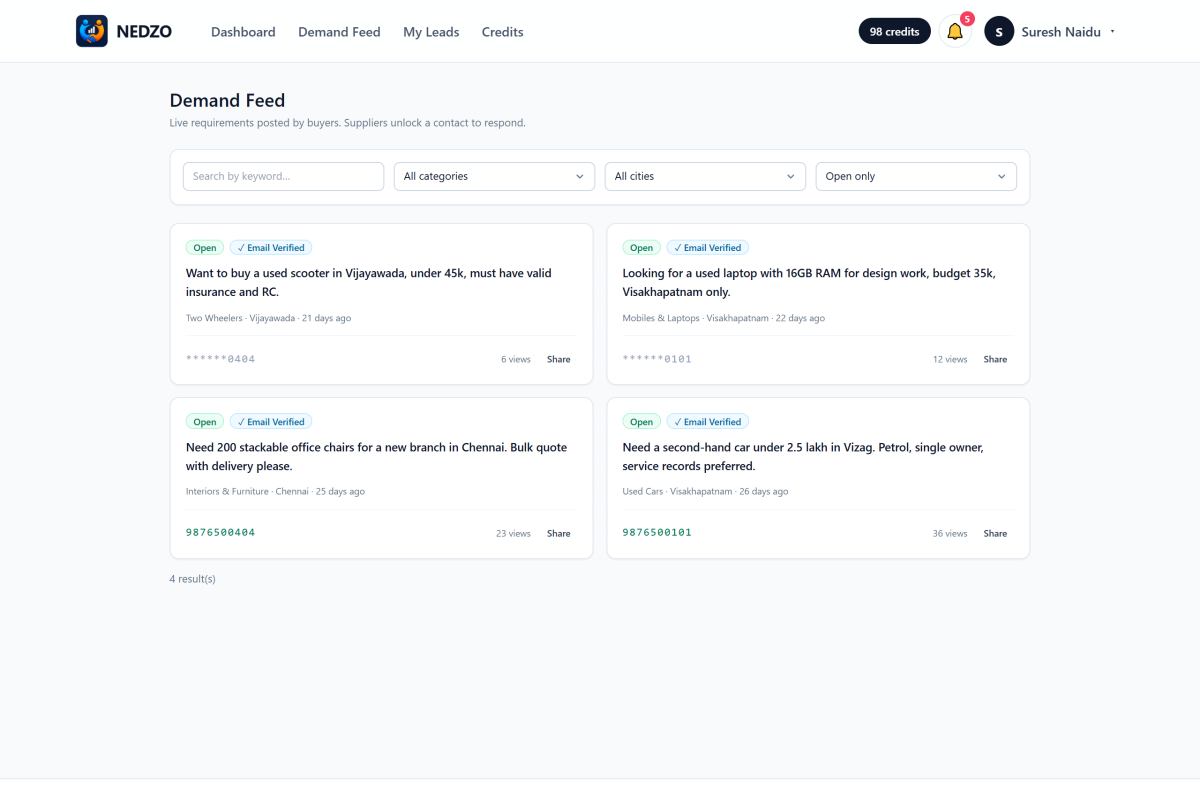
- The number is returned only to the requirement owner, an admin, or a supplier that has unlocked it
- Everyone else receives a masked string and a null value — nothing is concealed with CSS
- The buyer's email address is never exposed to suppliers
- Only open requirements accept new unlocks, while already-unlocked leads stay readable after closure
Credits and Ledger
- Configurable credit cost per unlock
- A uniqueness constraint per supplier and requirement means a repeat unlock never charges twice
- Every balance change is written as a ledger row with before and after balances
- Signup bonus credits granted the first time an account becomes a supplier
- Credit packages and an admin credit adjustment tool with a recorded reason
Payments
Credit purchases run through Razorpay with verification done server-side, never trusting the browser.
- Signature verification plus an independent re-fetch of order status and amount
- Webhook and retry-safe crediting through an idempotency timestamp
- Offline or manual purchases confirmed explicitly by an admin
- Purchasing can be switched off entirely from settings while the gateway is not live
Operator (Master) Accounts
A master user posts requirements on behalf of walk-in and phone-in customers. No customer email is collected and no code is sent, so the post goes live immediately, and suppliers still receive the customer's number.
Because there is no verified customer email, those posts carry a "Verified by NEDZO" badge instead of "Email Verified", and the provenance is stamped on the requirement row when it is created rather than inferred later.
Passwordless Sign-In
Sign-in asks for one thing: an email address. The server then decides what comes next — a six-digit emailed code for buyers and suppliers, or a password field for the admin, who is the only account that has one.
- Single-use codes with attempt caps, expiry and resend cooldown
- No password recovery flow, because only one account has a password
- JWT authentication with the active role pinned into the token
- Locally, codes are written to a log and shown in the interface instead of being emailed
Supplier Tools
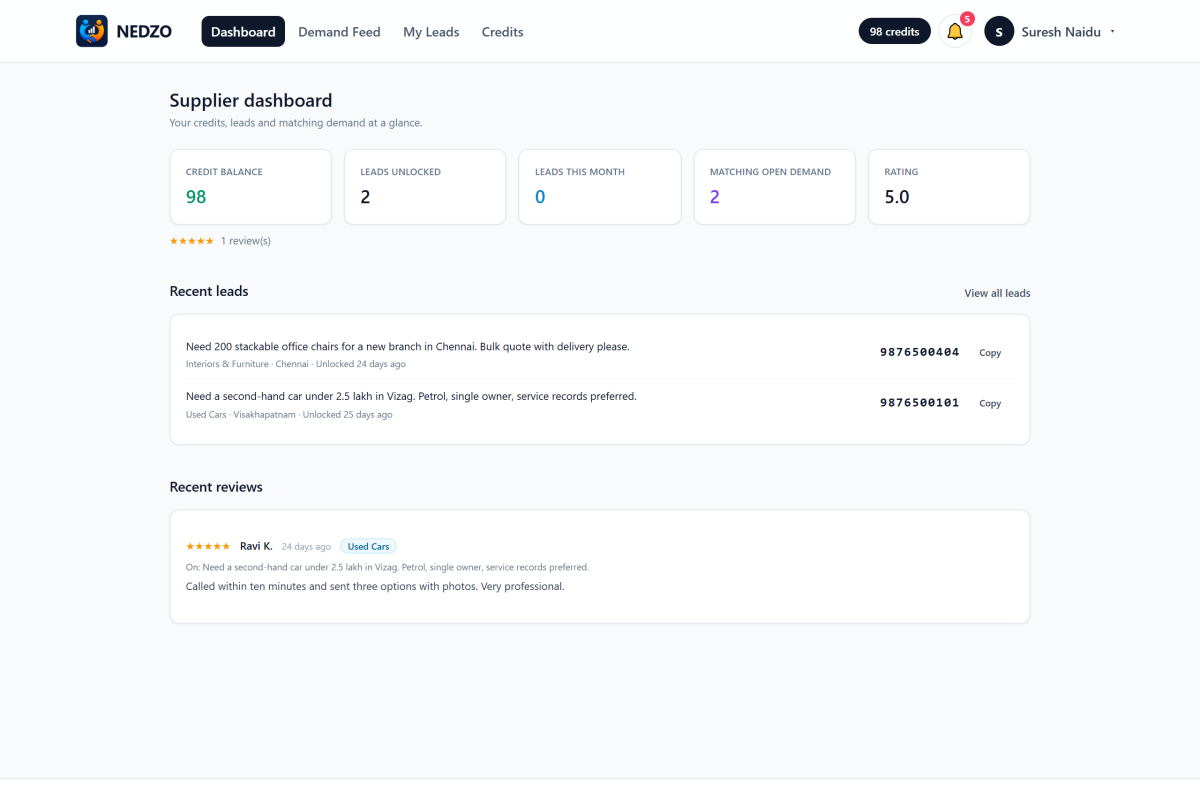
- Categories and cities served, which drive the matching demand count
- Filterable demand feed by keyword, category, city and status
- Credit balance, unlocked lead history with copyable contact numbers
- Public rating average and the reviews buyers left
Buyer Tools
- Post, close, reopen or mark a requirement fulfilled
- See which suppliers unlocked each requirement
- Rate suppliers after they make contact
- View counts de-duplicated per visitor over a configurable window
Admin Console
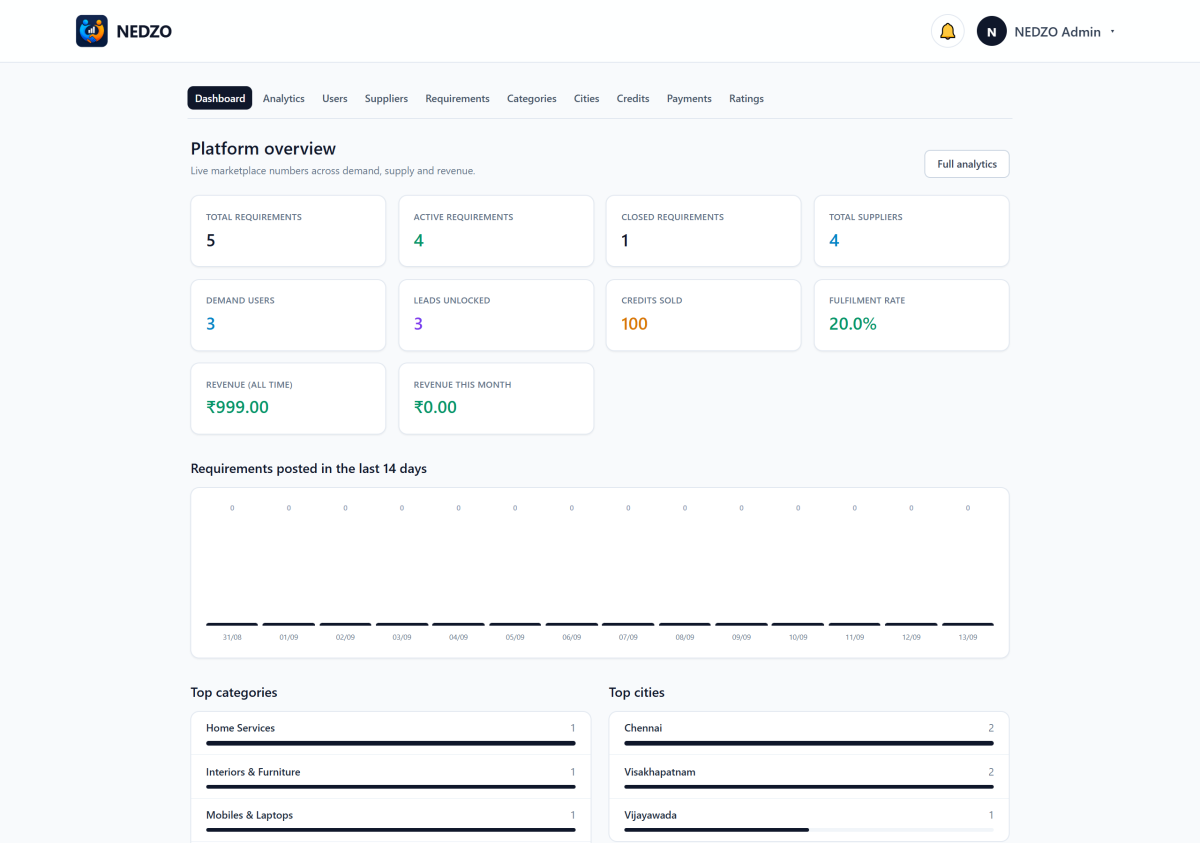
- Platform overview: requirements, suppliers, demand users, leads, credits sold, fulfilment rate and revenue
- Requirement charts plus top categories and cities
- User management with search, role and status filters, blocking and master-user grants
- Supplier, requirement, category, city, credit package, payment and rating administration
- Settings held in the database rather than hard-coded: unlock cost, text limits, code timings, page sizes
Platform Highlights
- Reverse marketplace: demand is posted, supply responds
- Requirement posting with no prior signup, verified by email code
- Credit-gated contact unlocking with server-enforced privacy
- No double charging on repeat unlocks
- Full credit ledger with before and after balances
- Razorpay payments verified server-side and idempotent crediting
- Dual-role accounts with role switching on one email
- Passwordless email-code sign-in
- Operator accounts for walk-in and phone-in customers
- Supplier ratings and reviews
- Category and city taxonomy with matching-based discovery
- Admin analytics and full moderation console
- Database-driven settings instead of hard-coded values
- No framework, no ORM and no build step